
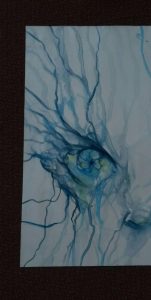
Gareth is my first interviewee who’s not a writer, and I’m proud to share his evocative, intriguing work.
Purchase his gorgeous work here: The Darkling.
Share his work far and wide; someone you know will love it.
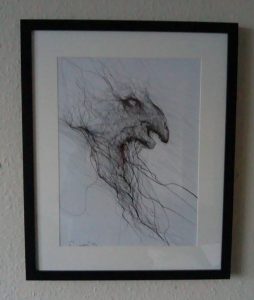
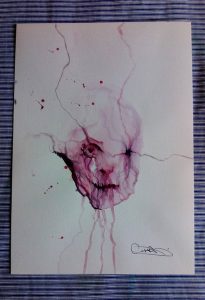
Tell me about your artistic process.
“Usually ideas will flit through my mind, and I try to store them in memory for future use. Sometimes the work in progress may go in different directions. Mostly I try to follow the natural flow as much as possible.
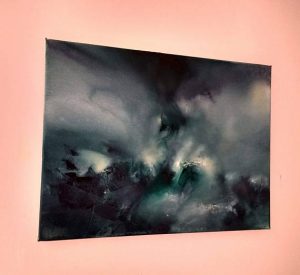
Your art is gorgeous and affordable. How do you determine price?
“Currently, I determine price by the time it takes to complete the work, and also which medium and materials are used.”
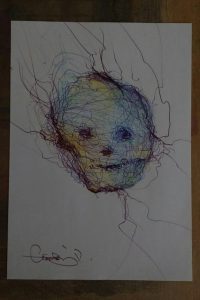
Explore the dark elements in your work.
“I choose colors in a very random way. A lot of my process is very much a kind of instinct. I like this as it keeps the work exciting, at least for me.”

Describe your studio.
“My studio is small and, due to finances, very limiting at the moment. I have various objects around which might prompt ideas, and reference photos. Usually inspiration comes from within, my memory, and dreams.”
What do you love most about your creativity?
“The thing I love most about creativity is the freedom from reality—the everyday, and how it allows expression of my feelings.”
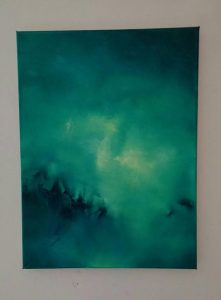
Go to The Darkling to see more of Gareth’s work. He’s always producing: ink sketches, watercolors, and oil paintings.
Get his work on your walls now while it’s still affordable!
Follow Gareth Walsh on Facebook and Instagram @dreemtimeart_.

 This story opens in an interrogation room, with Angela prepared to tell her story to police, if they will only listen. Finally, Detective Novak allows her to share everything that she feels is relevant, beginning with her meeting H.P. in high school, where he changed her life. They became best friends who fell in love, or as Angela tells the story, soul mates. She leads Detective Novak through their complicated relationship, hampered by her lack of a healthy role model and his small town contentment, and further strained by Angela attending Oxford, where she’s befriended by Freddy, who dotes on her against her will. Detective Novak perks up at the entrance of Saskia, the missing wife, the reason for Angela’s interrogation, during H.P.’s visit to England. Misunderstandings ensue, emotions tangle, and new pathways are formed. Angela blames losing her first love on everyone else, spending her life from that point on waiting for him to do the right thing. When her mother moves in uninvited after leaving her father, she pursues an unhealthy friendship with H.P. as their houseguest and babysitter, which culminates in Saskia’s disappearance. Detective Novak pieces together the evidence through the long night of storytelling by Angela, who is either also an innocent victim or a truly unreliable narrator.
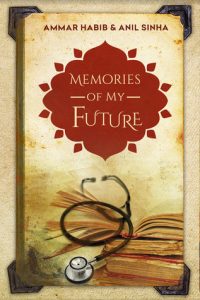 Surgeon Avinash Singh loses a child during surgery to heart failure caused by a new virus. Having accepted always being the best at everything he does, this harsh reality devastates him. His nurse Martha, a second mother in his adopted country, tells him to find a way to deal with it and get back to work. He seeks resolution in the journal of his ancestry given to him by his grandfather. He reads of Khau, the Lion of Bihar, a 13th-century warrior ancestor, who must find a way to save Bihar from the Mongols. Those barbarians destroy everything in their path, because they are unbeatable archers on horseback. Khau determines their weakness and defeats them. The inspirational story motivates Avinash to develop a cure. From this breakthrough, Avinash receives two offers: a position at a coveted medical center in NYC and a chance to offer his skills to a humanitarian effort. He returns to the journal to learn about Veeresh, the leader of his people who did not break under torture by the East India Company’s best “negotiator.” From this lesson, Avi knows he must follow his heart. On this path, he finds true love and faces a challenge that calls out to his warrior blood.
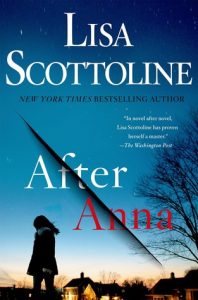 Dr. Noah Alderman is on trial for his life, accused of murdering his stepdaughter. Her father fought ruthlessly for custody of baby Anna as a power play after Maggie suffered the relatively unknown, but common, postpartum psychosis. With his recent death, Anna reaches out to the mother she wants to know. She enters the family, which includes Noah’s 10-year-old son Caleb, with a fortune from her father and an attitude of entitlement. Her accusations of molestation against Noah rend Maggie’s heart. Though circumstantial evidence points to Noah as Anna’s killer, Maggie retains a sliver of hope, not quite able to believe he is capable of such an atrocity. A phone call with shocking news sets Maggie on an investigation that may possibly free Noah and return him to her.
 The pa of the Glass children, Jimmy and Flower, dies of smallpox in a pestilent tent hospital in Deadwood, South Dakota. They had pulled him into town from their shack on his gold claim, proving their mettle. Madame Dora DuFran takes charge, and Calamity Jane, who’d followed Wild Bill Hickok to Deadwood, works in the pest tent, caring for their pa, watching him slowly fade. Jimmy and Flower, who goes by Hour, sleep in DuFran’s storage room, which previously housed Jane, who prefers to sleep off her routine drunks outside under the stars, anyway. Hour’s mom, a Lakota, visits Jimmy in his dreams to offer wisdom as he confronts challenges (one of which is first love) in their few weeks at DuFran’s brothel, until their pa passes. Jane holds a fundraiser for her “daughter” Hour’s education, receiving enough to send both children to a convent school, giving them a good start in life. Jimmy channels Jane in a life of constant travel, but Hour marries and raises a family in Kansas City. While working as a storyteller in the Buffalo Bill Wild West Show, Jane meets up with Jimmy and they catch each other up on their lives. Jimmy sees her only once more, in a small town where she was put off the train, at a hotel on her deathbed. The happily ever after comes to Jimmy when his first love finally leaves prostitution for marriage.
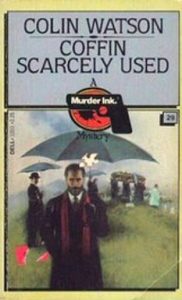 Councillor Harold Carobleat has died, having succumbed to a lingering illness. Soon after, his neighbor and solicitor are found dead under mysterious circumstances. As both are colleagues of Carobleat, and one suspected to be intimate with Carobleat’s wife, Inspector Purbright investigates Harold’s passing as a possible murder as well, eventually connecting it all to a shady business deal.
 The times were not conducive for a lesbian love affair. In this fictional version of Eleanor Roosevelt’s lifelong love affair with journalist Lorena Hickok, President Roosevelt is “in on the joke” and takes advantage with his blatant womanizing. Told from the perspective of Hickok, it’s a softly rendered portrait of Eleanor, all the loveliness of her and the imperfections softened. Readers also get a peek into Bloom’s perspective of the Roosevelt clan, with snarky remarks on cousins from Hickok, Eleanor, and FDR. Throughout the story, Hickok announces character flaws and strengths of the powerful people surrounding her, ever aware of her precarious position. Readers follow her career choices, through various relationships and friendships, and her ins and outs with Eleanor, who always chooses her as an add-on to her public, political life, even after her husband’s death.