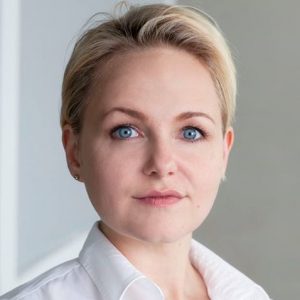
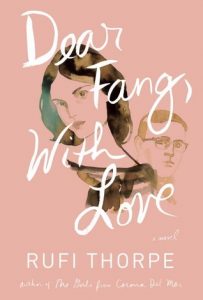
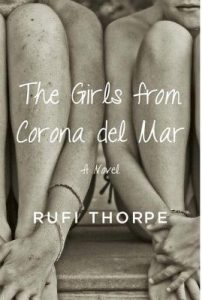
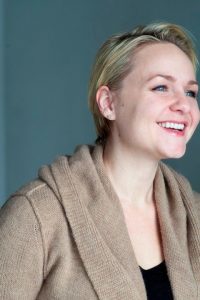
 Rufi Thorpe received her MFA from the University of Virginia in 2009. Her first novel, The Girls from Corona del Mar, was long listed for the 2014 International Dylan Thomas Prize and for the 2014 Flaherty-Dunnan First Novel Prize. Her second novel, Dear Fang, With Love, was published by Knopf in May 2016. Her third novel, The Knockout Queen, is forthcoming in 2020, also from Knopf. She lives in California with her husband and two sons.
She was also my teacher for a Catapult class (which I highly recommend—Catapult in general and any class of hers specifically) and my Twitter friend, which delights me. At the end of the interview are links to connect with Rufi online, and you too will be delighted. Then read her books!
Describe your writing process: schedule, mechanics, environment(s), nuances, and inspirations tangible and abstract. What’s in your head? What’s in your office? What keeps you going?
Because I have two small children, much of my writing for the past six years has been stolen during naptimes. My first son would only sleep if I was beside him, and so I got used to writing in bed right next to him as he napped, semi-recumbent, my laptop on my thighs. With the second one, he just didn’t fucking nap, and so I hired my husband’s cousin to come nanny for us, and she would take him for three or four hours in the morning, and I would sneak away to try desperately to assemble some sense of self, usually in my mother’s apartment, which was adjacent. For some reason, I hardly ever turned on the lights and it was dim in there, and my boobs were full of milk, and I would pull on my own hair and stare at the screen and think: who am I?
 Now my children are older and I have many more hours while they are at school, but those hours still feel somewhat stolen, and that lends the act of writing some urgency. I have never, for instance, had to worry that I would fritter away my few hours with social media. I am also, for better or worse, one of those writers who enjoys the act of writing itself. I enter a kind of narcotic stupor, and I can write twenty pages and then kind of “wake up” and have to figure out if anything interesting happened in them or not. I have to throw away a lot, but it also means I think I torture myself less than is common. Both because my time almost always feel stolen, and because I actually enjoy writing more than any other activity I do, my writing time has almost no ritual element. I don’t have to get in the mood, or become inspired. All that is required is a computer. I suppose the only truly odd thing is that I prefer to be entirely alone and dislike it even if someone is in the next room.
Walk me through your publishing process from final draft to final product, including who does what, how much input you’re allowed throughout, and marketing expected of you.
Oh, interesting! No one has really asked me that before! So, when I finish a first draft, my first move is to show it to a few close friends, also writers, who give me feedback. Then I usually put it away for a while, like aging beef! Then I revise, put it away, revise, put it away. When I’m not sure how else I could possibly improve it, I send it to my agent. That whole process, the beef aging, can be about half a year. Then my agent has LOTS of ideas about how I could improve it. My agent is an incredible editor. I’ve learned more from her than I did from my MFA. So then I rewrite it again. Sometimes she has massive problems with something, sometimes very minimal tinkering. This part takes anywhere from one month to three.
Then we show it to my editor, and (hopefully) she buys it. Once the offer has been made and accepted, then my editor and I usually have a big phone call talking about edits and marketing ideas and how our children are. She just bought my third book, and she’s bought all my books, so we’ve known each other for… six years now? I love her very dearly. Usually her editorial suggestions take anywhere from one month to four months to implement, and then I submit the final manuscript! But it is also, of course, not done yet. Final manuscript is a misnomer. There are still months and months of copyediting to go through.
 The book undergoes four rounds of copyedits, which involves changes made by the copyeditor, which I then review, everything from spelling or grammar errors, typos, to “would a football game be on at this time of the day on west coast time?” Copyeditors are amazing people. At around this time, you start to see cover mock-ups. While I don’t think I have full cover control, i.e. the ability to legally veto a given cover, my publisher very much wants me to be happy, and if I have a big problem with something they will try to accommodate me. But I’ve been very happy with all the covers they have shown me, so we have never had to really duke it out.
In general, from accepted manuscript to the hardcover publication date is about a year. It’s an incredibly long pipeline.
In terms of marketing, there are parts I am central to, like writing letters to booksellers to be included with ARCs, or going to marketing lunches with booksellers, or doing events once the book is out, and there are other parts, like seeking review coverage, that I don’t have any knowledge of. I do try to write some personal essays to come out the weeks before and after the pub date, just to try to get my name out there, to get passed around on social media. I have no idea if these essays actually sell copies, but I have very much enjoyed learning more about how to write an essay, and they have caused me to read far more essays by other writers than I might have otherwise, so I am quite grateful for that process.
Tell me about your support system—who are your cheerleaders?
My mother and my best friend, both of whom are also writers. They read my drafts, they nurse my insecurities, they agonize with me through every part of the process, from wading out into the primordial soup of a book I am just figuring out to weighing in on the narrator options for the audio book. They are the two smartest women I know, and I would be lost without them.
How does life influence your art; does your work influence your life?
I am not an autobiographical writer, and I don’t ever write characters who are “me” or even who share a lot of biographical detail with me. But certainly life influences art. Your life is your reality, and your art is a depiction of your reality, your convictions: justice is possible or not possible, love is real or illusory, man is moral and celestial, or man is base and animal.
As far as my work influencing my life, I suspect it does in so far as I prefer imaginary people to real ones, and I have been indulged in that to an extent that now I am shit at small talk, and I just get really weird and awkward really fast. It doesn’t happen so much when I’m teaching, but put me at a PTA meeting and I’m sure to tell a woman her earrings look piratical “in a good way” or something.
What do you love most about your creativity? Teaching others?
Well, teaching I love because it is so straightforward. The task is pretty much: “help these people learn to do this thing.” It’s much easier then other tasks, like, “Get these people to win this war,” or “work hard at very boring spreadsheets whilst simultaneously performing complex social hierarchy maneuvers.” I would be bad at both of those! Helping people to learn something is actually very straightforward. You simply tell them everything you know about a given subject and then try to earnestly answer their questions. And of course, every time you teach something you come to understand it in a new way, and the questions you are asked are usually very surprising and interesting and make you think in new ways, so the end result is that you end up learning a lot from your students in the process of trying to teach them something, which makes it extremely rewarding. I mean, I think it is very rare in life that just being earnest and open is all you need for success, but teaching is like that.
Writing is a whole other thing. On the one hand, writing can be very lonely, because no one can really tell you how to do it, and you spend many hours alone, just striving, and you can never really feel satisfied with what you have done. The moment of connection with the reader happens away from you, you don’t get to see it. Sometimes they send you letters and that feels good. It is almost overwhelming to think you have had that kind of effect, and you can’t help but feel very grateful that they have taken the time to write you, but there is another way in which it feels like it has nothing to do with you, like they are simply reporting that they ran into your doppelganger somewhere else where you have never been. And they are like, “Your doppelganger! She was amazing!” And you’re like, “Wow, I’m so glad! I’ve never met her, I hope she is nice.”
But writing is also the place where I am my truest, most essential self. My most real connections to this world have taken place in books, and I am intimately connected and indebted to many novelists I have never met. It is a strange, anonymous intimacy. And if I were to write to them and tell them about it, it would be as useless to them as if I told them I had run into their doppelganger at a Macy’s in south Orange County or whatever. “How nice,” they would say. “Thumbs up.” And yet, they have spoken to me about reality more deeply than I am able to communicate with even my husband. What is one to make of such a connection?
But to get back to your question, which is what do I love about it, I think what I love about it is that it is the place where you get to earnestly try to figure out what the fuck is going on. Why do people hurt each other? What does love look like? Does doing bad things make you bad, or do you have to be bad to do bad things? How well do people know each other?
The writing always asks you: What do you know is true so deeply that you didn’t know you knew it?
And you have to try to answer.
 Connect with Rufi:
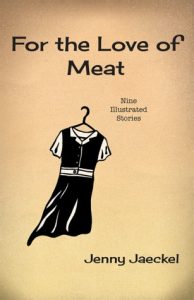
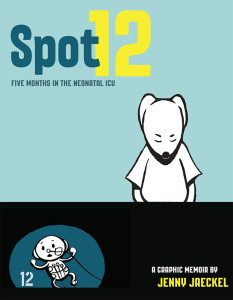
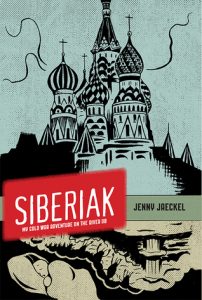
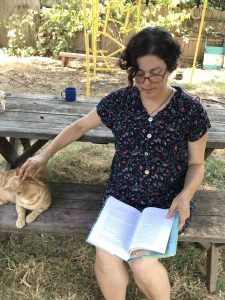
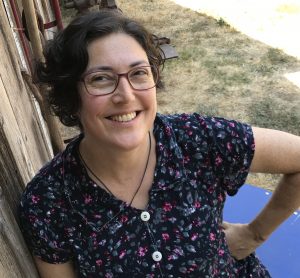 Jenny Jaeckel is the author of House of Rougeaux, her debut novel, which made Bitch Media’s 25 Must Read Books of 2018 list. Her previous titles include For the Love of Meat: Nine Illustrated Stories and Siberiak: My Cold War Adventure on the River Ob. In 2016, Jaeckel published the graphic memoir Spot 12: Five Months in the Neonatal ICU, which was the winner of the 2017 Next Generation Indie Book Awards and a 2016 finalist in the Foreword Indies Book Awards. She has worked as a translator, an editor, a Spanish teacher, a graphic arts teacher, and an illustrator. Jaeckel is currently working on her second novel, yet to be named, a continuation of the Rougeaux family epic.
 Wow, where to start… All the aspects of the process, whether internal or external are quite varied. As a writer, I have to have a whole mental “team” going on: the passionate one, the researcher, the emotional digger/investigator, the critic, the cheerleader, the scheduler, etc. etc. My biggest inspirations are my favorite books, the ones I love with all my heart and soul, and have made me want to be a writer in the first place. I always aspire to those literary heroes. They function like my North Star. I may be down in my clunky little rowboat, with my one broken oar, paddling furiously and getting nowhere, but when I look up, at least I know where I’m trying to go. J.D. Salinger, Toni Morrison, Merce Rodoreda, Eduardo Galeano, and Edith Wharton are some that I return to again and again.
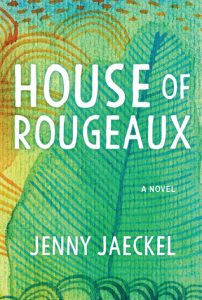 One of the most key parts of the process for me is working with my editor, Neesa Sonoquie. When I first showed her the manuscript for House of Rougeaux, I thought it was in pretty good shape. I’d already gotten some feedback from readers I trusted and done a lot of revising. But I had not worked with Neesa before. She absolutely demolished it. I’d sent off a book and got back confetti. It was humbling, but it turned out to be a transcendent moment. The revision process transformed the book and made me grow tremendously as a writer.
 I don’t exactly have a cheerleading squad, but I have a small group of friends and acquaintances who have, at one time or another, said, or written some very wonderful things about how my work has touched them. When I get this in an email, for example, I print it out and put in on the wall by my bed, where I have a little collection, and when I get discouraged, I read them over and over. I also talk pretty regularly with three writer friends of mine. Though we all deal in different genres, the process and the struggle are the same, and being able to engage in that mutual support is essential. My lovely family is very supportive too. My partner and child give me regular feedback on my blog posts and written interviews (like right this second).
 Art and life have a complete interface for me, like body and mind, or heads and tails sides of a coin. My first three books were all memoirs, the next two pure fiction, so while my relationships to all those topics varied, it was all deeply personal. When writing memoir, it has been much easier for me to see the therapeutic aspects of storytelling. Curiously though, putting key chunks of my life into these packages called books has made me identify with the stories less, as if these events happened to a human, and that human just happened to be me. It’s very liberating.
 I am grateful to creativity for being the force that animates me. I think without it I’d be a lifeless hulk, a Frankenstein’s Monster pre-electrification, misshapen and covered in scars and moldy clothes (but smaller). I was lucky that as a child I was encouraged in art (so many are discouraged or even shamed for their efforts,) and lucky that since then I’ve had countless opportunities to grow creatively. Creativity takes infinite forms, I think it’s our birthright as human beings, and I think the more we can bring it to all aspects of our lives the better off we are. Once I heard the singer Krishna Das say in an interview that his music was how he stayed alive. He didn’t say music was his bliss and all that, he said it was how he literally stayed alive. I really appreciated that. It’s survival. Creativity is not the icing on the cake, it’s the cake itself.
 Connect with Jenny:
 Describe your writing process: schedule, medium, environment, strategies / techniques, and inspirations mental, emotional, and material.
 Talk me through the publishing process from final draft to final product and selling—who’s involved, what they do, and how much you contribute, especially to marketing.
 Who’s your support system, online and IRL? Does it shift as you progress from writing to publishing to marketing?
 How does your writing influence your life and vice versa? Did this change when you became a mother?