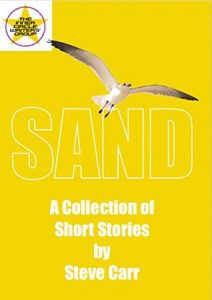
 Steve Carr’s first collection of short stories is fantastic. His work is intense, reaching into the reader’s head and twisting emotions, shattering logic and reason. The first story Tenderloin is—pun intended—a punch in the gut, as the reader sees the grittiness of the setting and feels the coiled tension in the main character, a veteran of the Iraq War. With journalistic expertise, Carr displays monstrous humanity in a brevity of words, as in The Saguaro Two Step, in which the woman wins the loot in the end, and exposes desperation, as in The Festival of The Cull, wherein Shamina can no longer vote on who is to be terminated. Reality bends as one ventures further into the book, as in the self-explanatory The Girl in a Mason Jar, gets fishy in Strange Water, and disappears in When Wizards Sing, where animals and men blend. The stories are diverse, with main characters of various genders, sexual orientations, ages, cultures, and even species. The book ends with stories of the afterlife on a never-ending train ride for incorrigibles, a man’s struggle for gravity, and the misplaced hope of a senior citizen. Definitely a must-read! Follow Steve on Facebook and Twitter. Purchase Sand at Lulu.com or Amazon.com.
Monthly Archives: April 2018
Prompt: Writing Bad photo
Never Touch It
I couldn’t stop looking at it. None of my friends had cell phones. Dad had argued that a ten-year-old didn’t need a cell phone, especially in a small town where everyone knows everyone’s business. My mother was a smotherer and had been working Dad for years, and now I had a Smartphone.
“Jimmy, put that stupid thing away and come on!” Ronak screamed back at me as he raced down our street toward the forest.
I stuffed the phone in my shorts pocket and rode after him, feeling the bulk of it banging my thigh as I pumped. It felt like I had the world in my pocket. The forest surrounded me when I hit the edge of the road at the T and bounced along the dirt path to our treehouse that Ronak and I built two years ago.
After dropping my bike next to his, I climbed up the rope ladder to find Ronak waiting impatiently. He too loved to play Angry Birds on my phone and hated that I always played first. It was my phone. I settled into the pile of pillows next to him and pulled out my phone. The game icon was on the screen. I poked it and started level 34, which was killing me. Because of the challenges at certain levels, we’d instituted a new rule of all lives lost before switching if we didn’t level up.
“Dude, you suck!” he yelled as he punched me, bumping my arm, which caused me to miss my target and lose my last life. He snatched the phone from me.
“That’s not fair! You made me lose my last life!” We wrestled amongst the pillows, pushing them out of the way, scraping our elbows and knees on the rough wooden floor from the unfinished wood planks. A tingle-a-ling-a-ling announced a text. “Give me my phone. That’s a text from my mom. If I don’t answer it, she’ll make me come home.”
Ronak handed me the phone with a sigh and rolled onto his back to inspect his elbows. I looked at the text. Mom didn’t usually text so soon after I left. Mostly just to let me know to come home for lunch.
“Look. It’s not from my mom.”
“What? Who else would text you? I though only your mom had your number?”
We read the text together, “Don’t touch it! Never touch it!” There was no number, only a blank space.
That was the first communication from Lorena, who explained that she lived in a parallel universe. Even though they could read her texts, my parents called her my invisible friend throughout my entire childhood, convincing my best friend, though he’d been there for the first message.
For years, I had no clue what “it” was, for she was not forthcoming with an explanation. We discussed everything else. Her responses came always a day later, apparently due to some time-space interference that I still don’t fully comprehend. She had no clue why we could communicate by text, just that it was a rare phenomenon which made her a minor celebrity in her town and me a weirdo in mine.
In a new home way out in the country, my dad decided to get satellite TV, and a dish hung off the southwest corner of our house. We got some new stations, some in different languages, intriguing my dad, who watched despite the language barrier. He especially loved Bollywood films in Hindi.
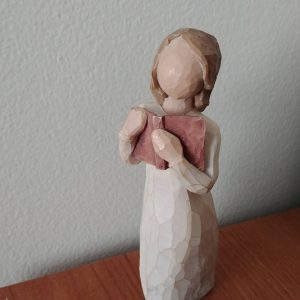
“Dad, that’s the doll! In the left corner on the dresser.” He spit air through his teeth and changed the channel. “There it is again! I swear—on the bookshelf next to the blue book.” Another channel.
Before I could point it out on top of the fridge in the soap opera, Dad burst out with, “Stop it! Just stop it!” He took a deep breath and continued, “Son, it’s not there. You’re old enough to give up these games. No one sees it. It’s not there. No connection with your invisible friend. It’s time to let her go, Jimmy.” He held out his hand to me, man to man. “Deal?”
I shook his hand and said, “Deal,” and mentioned it not once more, though it appeared on every show.
Again and again, Lorena texted, “Don’t touch it! Never touch it!” Why, I don’t know. It was on TV. I couldn’t touch it.
Until I was 21 and saw the little, pinkish, angelic papier-mache doll in a store, sitting on a shelf next to toothpaste. Then another store, right by the candy I was choosing. I noticed it as I was picking up the bag, and I dropped the bag at my feet, picked it up, and went on my day. It was unnerving to be so close to a forbidden object from a parallel universe that no one else here could see.
I married in my mid-30s a widow with two children, children I adopted and love as my own. Lorena knows about my wife, yet she remains my secret. I’m still in the dark about her connection to the freaky, papier-mache doll that I’m now seeing everywhere. My wife knows nothing.
Last Tuesday, the doll appeared in the fridge behind the milk. I spilled milk all over the floor when I saw her. I cleaned it up, but I did not cry. Honestly, I wanted to cry. I mean, in the fridge…really?
Lorena chose to stay with the woman who was selected as her youth partner after school. She says this often happens. I’m glad she’s happy. I know that throughout her life she has continued to be a recognizable figure for her unusual connection to me. I, however, may be going mad from it. That freaking doll is everywhere, and I’m not supposed to touch it. I don’t know the consequences of such an action, but my lifelong fear of accidentally doing so keeps me on edge as she proliferates in my life. I have no one to talk to about this. Not even Lorena.
I now stand still in my living room, staring at my little girl as she gradually morphs into a little, pink angel.
Echo Moon (Ghost Gifts #3) by my favorite ghost writer Laura Spinella
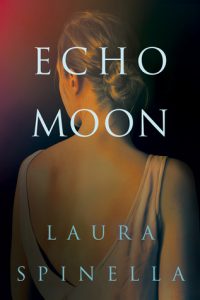 Echo Moon finishes the Ghost Gifts trilogy, beginning with Aubrey and her souvenirs from ghosts she helps that she calls “ghost gifts,” through her marriage to journalist Levi St. John, to their son’s story of his past life, wherein he envisions shooting his true love Esmerelda Moon—Esme. Spinella pulls the reader into an early 20th-century culture of supper clubs and amusement parks, showcasing Luna Park of Coney Island, with its rides, performers and customers. We even witness the shadier “rides,” “performers,” and “customers” of the Elephant Hotel, a brothel set on the edge of the park. The hotel is real, but turned brothel after the heyday of the family-oriented park, and pulls Spinella’s story into the historical fiction genre as she carefully blends it into her novel.
In Ghost Gifts, Aubrey solves the mystery of Missy Flannigan’s decades old, cold-case murder with a recalcitrant Levi St. John, and they reluctantly fall for each other. In Foretold (Ghost Gifts #2), Aubrey and Levi are raising their son Pete, who suffers nightmares that are actually visions of his previous life as a photojournalist in WWI. The investigation of a John Doe (who turns out to be Aubrey’s friend Zeke) murder in which Levi is assisting culminates in the kidnapping of Pete, who is of course rescued by his parents. In Echo Moon, Pete finally solves the murder of Esme, with the help of Zeke’s niece Emerald—Em. Spinella spins coincidences into relevant evidence and drops the solution out of nowhere, but it all makes perfect sense. She has a way of surprising the reader without making the reader feel dumb for missing clues, and her characters are colorful and complex.
I received an early copy of Echo Moon from the publisher in a giveaway. Thank you, Laura! I love it! Visit her website to follow her on social media and purchase her books. Tell me a personal experience with the paranormal in the comments, and I’ll choose a random winner to send my ARC of Echo Moon!
Ammar Habib—Award-Winning Author

Ammar asked for a reader on Twitter to review his novel Memories of My Future. Intrigued, I asked him questions, all of which he readily answered, before I agreed. The story he wrote with Dr. Anil Sinha is fantastic—read my review.
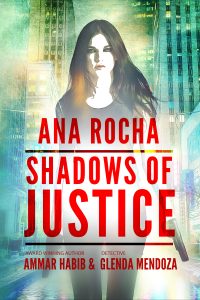
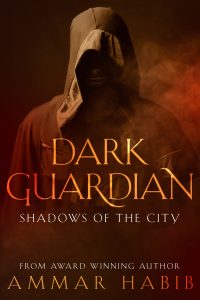
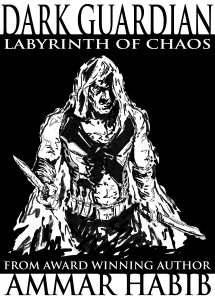
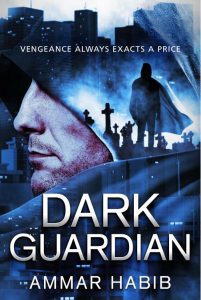
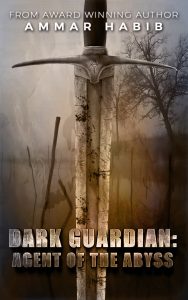
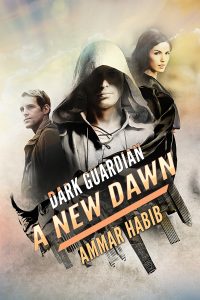
Ammar exudes friendliness and positivity in his online presence and digital communication, and I always feel cheerier after speaking with him. He has also written a vigilante series called Dark Guardian, and his latest book Ana Rocha: Shadows of Justice was co-authored with a detective.

Describe your writing process, including environment, schedule, strategies, and inspirations.
My writing process is somewhat structured and somewhat fluid. It always begins with a theme. I ask myself, “Why should readers read this? What do I hope they get out of it?” As entertaining as I hope my stories are, I want them to hold some sort of moral lesson or theme for the audience as well. At the same time, I don’t want to slap readers in the face with this theme. Instead, I want to show it in the characters and story arc. So I take a lot of time in figuring out who my character are. As far as pre-writing goes, I probably spend more time fleshing out the characters than I spend on any other aspect of pre-writing. Many times, putting in the effort to create three dimensional characters is the separator between good and great work.
However, with that said, my writing process is very fluid. I like to try and create an outline before I go into the actual writing. But many times I find myself starting the first draft before I’ve even finished my outline. The inspiration comes in bursts so I try to capitalize on those bursts as much as I can. I find that being too stringent on my writing process can actually become a hindrance.
As far as inspiration goes, I honestly draw inspiration from everywhere. I’ve possessed a huge imagination since I was a child, so that is usually my biggest source. I have a hard time switching my imagination off, which can be a problem when somebody is trying to talk to you and you’re imagining a battle scene in your head! The other place I really draw inspiration is from the world around me. I try to stay observant because sometimes the best inspiration passes by right in front of you!
My environment and schedule do change based on circumstances. I don’t have a set place where I do my writing and my schedule varies because I can honestly write any time of the day or night! There are some days where I spend hours writing or revising manuscripts, and there are other days when I may spend only thirty minutes.
I love Memories of My Future—tell how you built on historical events through folklore, and the history behind the book itself, working with Dr. Sinha to create an inspirational story.
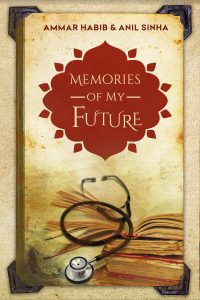 Memories of My Future is definitely one of my personal favorites. It takes place in three time periods: 13th century India, 19th century India, and present day New York City. The project began when I got a phone call from Dr. Sinha, whom I somewhat knew beforehand, in September 2014. He had the seeds of an idea that he wanted to write a book about, which was very similar to something that I was wanting to write about, which is why we decided to partner together. The reason Dr. Sinha reached out to me was because he had just read my debut novel, Dark Guardian, and had really loved it.
From there, we grew a story with themes of coexistence and courage. When we were researching the events of the 13th Century, there honestly was not much to be found because the history of the Bihar province has not been as well kept as it should. However, along with some facts and dates that we were able to gather, there was plenty of local folklore and legends about the events that are described in the story, and those legends were the basis for that piece of the novel.
Explain how you work in so many genres, and the challenges and satisfactions of doing so.
Like you mentioned, I do write in multiple genres. Many authors do see this as a challenge. For me, I’ve found that spending a lot of time up front with my planning and taking the time to nail down a theme, tone, and characters on the front end helps me write the story within the parameters of the genre I am aiming for. As a writer, I never want to be limited to a specific genre because I’m one of those people that doesn’t like limitations in general. So the ability and freedom to write in multiple genres is a very liberating feeling!
Describe your research process, including how you find sources and what you choose to use.
For works like Memories Of My Future, where a lot of research is required, I definitely do take my time with it. Research is something that should never be rushed. I always try to use as many scholarly or peer-reviewed sources as I can. This is to ensure the authenticity of the material. Working at a college, I have access to the college’s databases, which have tons of articles over a variety of subjects, so that is a major help. If I am using a source that is not one that would be considered scholarly, I always try to verify its authenticity by cross-referencing it with something that is more academically purposed. I know everyone has their own methods for research, but that is the basis for mine.
What do you love most about your creativity?
For me, creativity is synonymous with freedom! It’s the freedom to create. The freedom to inspire. The freedom to affect lives. I always try to use my creativity positively, with the hopes of inspiring others. I view creativity as an asset and as a responsibility, just as I view any other talent or ability. Therefore, I try to use it in a good way. Thankfully, I can say that there are a few other authors I’ve met throughout my journey as a writer who have said that I have helped them along the way since I was further along the road than they were at the time, and honestly that’s the kind of thing that inspires me to keep moving forward!
Connect with Ammar and purchase his books:
 Ammar Habib
The Gods of Howl Mountain by Taylor Brown
Secrets are Held Closely in the Mountains
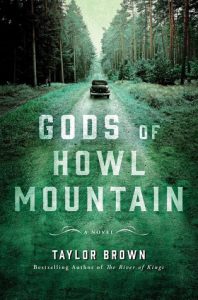
Granny May Docherty lost her daughter Bonni to Dix Hill 30 years ago when nightriders killed her boyfriend, the mill owner’s son Conner, silencing her voice. Her grandson Rory lost his leg to Korea, limiting his employment opportunities on his return home, leaving him little choice but to become a whiskey runner for Eustace Uptree, his best friend’s uncle and Granny May’s lover. Brown takes readers through the rabbit hole away from Mad Men and the American dream of a white picket fence to the colorful and dangerous world of Appalachia, where reigned illegal whiskey and wannabe drivers for the newly founded NASCAR.
A middle-aged wood witch and former prostitute, Granny May longs to know who hurt her girl, but fear of consequences prevents her from pursuing it with Rory. Brown’s subtle backstory of Bonni and Conner’s romance contrasts with the rawness and graphic depiction of mountain life in the 50s. Flooding of mountain valleys for “progress” disrupted Appalachian culture and forced a reluctant relationship with those living in towns and cities. Amy Greene’s “Long Man” shows the resistance of one woman against such flooding by the government. In Brown’s story, the event is long-reaching, since the main road literally heads straight into the man-made lake. As in Amy Greene’s debut novel “Bloodroot,” a body part is used as symbolism of a South yet alive with Pagan ways while tightly holding its secrets.
Taylor Brown digs out niches in his historical fiction—last vestiges of whiskey runners and nascent NASCAR, river kings, the lawlessness at the end of the civil war—getting down to the nitty-gritty of hard-living, developing complex characters who maintain their integrity in impossible situations. He gets a bit too “real” sometimes; for instance, there’s a lot of spitting in this book, some of it from Granny May—so much spitting. In one scene, Eustace flicks his nephew in the nuts. Graphic details can overwhelm the reader, such as when Rory’s rival purposely hits a deer and Brown describes the specifics of the deer’s physical suffering. Having said that, the reader leaves the novel with a sense of having learned history not found in textbooks, such as exactly what someone who drives illegal booze through the mountains does to his car to outrun the revenuers. It’s a definite must-read.
Sisterly by Jorja DuPont Oliva
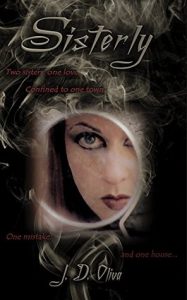
Janie returns to her hometown to make things right with her sister, and her ex-boyfriend who married her sister, by revealing her secret to them. She stays in the yellow house run by Mrs. Francis, where the otherworldly seems to creep in, everything is too connected for reality, and Mrs. Francis forbids her to enter the mysterious, yet beckoning, backyard. Though the dialogue is stiff—no contractions are used, and can sound unrealistic—Mrs. Francis’ dialect is over the top, the characters’ interactions with each other and Janie’s “episodes” are vivid. When Janie’s missing time and chaotic, dreamlike events are explained in the final scenes, the brilliance of Oliva’s storytelling skills burst forth like fireworks. Though hints are sprinkled like candy throughout the story, the reveal is surprising, and the reader can only be impressed by the descriptive details and timeliness of those “episodes.” References to the inciting incidents are well placed in the story, with emphasis in the reveal for a satisfying ending.
The author offered this novel gratis in March and I was fortunate to pick it up and read it, posting a review for the book gift and for my delight in the story. Thank you, Jorja!
The Little French Bistro by Nina George
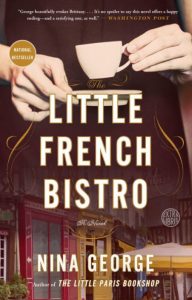 Finding Femininity and Feminism in France
“Does love have to be earned through suffering?”
Marianne determines that the Seine is preferable to one more minute of accommodating her husband’s controlling condescension. She walks away from the tour group during dinner to dive into the river, and her husband does not even notice her leaving. A homeless man “steals her death” by pulling her from the water. In the hospital, her husband expresses his concern that her attempt affects him adversely. She again walks away, bent on reaching Kerduc, the seaside town depicted in the nurse’s placemat tile, a town in which she invests her romantic notions of a larger death than her life has been. Circumstances lead her there as if by magic, pulling her into a setting amongst colorful, complicated characters that could have been created by Maeve Binchy. She falls into employment at Ar Mor restaurant, fitting seamlessly into the rhythms of the kitchen. At 60, Marianne begins a new life, of wonder, of real love, of authenticity. Toward the end, the novel gets a bit over the top (with the young waitress Laurine inexplicably removing all her clothing to rescue Jean-Remy’s love letter boats from the water, but maybe that one’s a French thing), yet maintains the integrity of its characters and Breton setting. A woman blooming into a fully realized individual after decades of being an extension of her spouse evokes feminism, when she can see herself as an equal to her lover.
Brittany, France, stands proud as a character in this story, new friends emphasizing Breton identity and sharing Breton folklore. Marieanne’s mysterious introduction to the community as “the woman who came from the sea” invokes the legend of Ys, the city swallowed by the sea, and her new love takes her to the magical forest of Broceliande. Although German, Marianne feels at home amongst her new friend, from the little touches, such as her return to playing the accordion, a long-stored instrument given to her by a Breton reluctant to fall for her charms based on memories of the war. She discovers that there are various ways to thwart love and defy romance. In another nod to Maeve Binchy, the ending provides closure without complete resolution, as in real life. There is death, rekindled romance, illness, love rescued, dementia, and new life, with all their complex and tangled emotions.
International bestselling author Nina George, after “The Little Paris Bookshop” (translated into 35 languages), again lays out beautiful, complicated relationships in seemingly impossible situations and offers readers wildly emotional connections and absolution as human beings in “The Little French Bistro,” on its way to multiple translations.
I was fortunate to receive a copy of this wonderful book through NetGalley.
Gareth Walsh—Artist and Illustrator

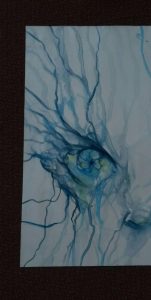
Gareth is my first interviewee who’s not a writer, and I’m proud to share his evocative, intriguing work.
Purchase his gorgeous work here: The Darkling.
Share his work far and wide; someone you know will love it.
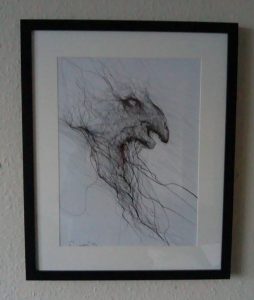
Tell me about your artistic process.
“Usually ideas will flit through my mind, and I try to store them in memory for future use. Sometimes the work in progress may go in different directions. Mostly I try to follow the natural flow as much as possible.
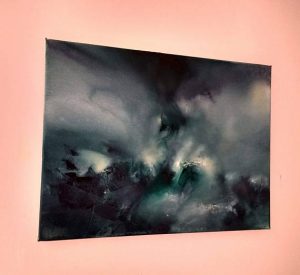
Your art is gorgeous and affordable. How do you determine price?
“Currently, I determine price by the time it takes to complete the work, and also which medium and materials are used.”
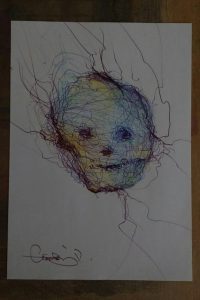
Explore the dark elements in your work.
“I choose colors in a very random way. A lot of my process is very much a kind of instinct. I like this as it keeps the work exciting, at least for me.”

Describe your studio.
“My studio is small and, due to finances, very limiting at the moment. I have various objects around which might prompt ideas, and reference photos. Usually inspiration comes from within, my memory, and dreams.”
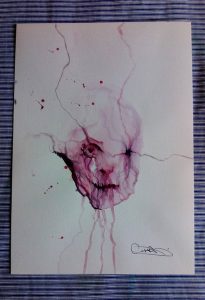
What do you love most about your creativity?
“The thing I love most about creativity is the freedom from reality—the everyday, and how it allows expression of my feelings.”
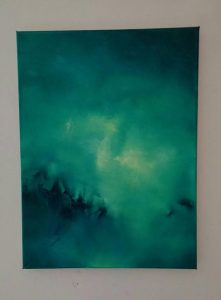
Go to The Darkling to see more of Gareth’s work. He’s always producing: ink sketches, watercolors, and oil paintings.
Get his work on your walls now while it’s still affordable!
Follow Gareth Walsh on Facebook and Instagram @dreemtimeart_.
Prompt: Writing Bad photo

Sharon watched the teenagers approach, knowing the helmet screen was a 2-way mirror. She screamed and banged the metal with her fists and stomped her feet, but cushioning absorbed the sounds. The girl jumped back, startled. The girl asked the boy a question, but he shook his head. The girl blinked a couple times and laughed when the boy poked her and thrust his hands at her to scare her.
Hope died like a candle extinguished. She recalled when she and her boyfriend had come out to the deserted shack deep in the forest, where the inexplicable astronaut suit stood. Rumors held that it came from a defunct amusement park. It had no real functionality, made from metal and heavily solid, as evidenced by the girl tapping on it and pushing it.
Sharon’s boyfriend had gone into the shack while she had investigated the suit. A hand had clamped over her mouth, holding her head tight to someone’s chest as another hand reached around to open the astronaut with a little key that had not been obvious to her. The hands shoved her into the astronaut so quickly that she’d not even thought to fight back yet. She was positioned in a flash and the astronaut suit closed. She didn’t hear the snick of the key, but once she recognized her situation, she found that the suit was securely closed.
Her boyfriend wandered out of the shack, shrugging as though there were nothing to worry about inside. She’d been looking forward to this new adventure—outdoor sex in a forbidden area. Now she witnessed her own disappearance through her boyfriend’s behavior. He called her name for hours, beat the hood of his car, and drove away. Returning with him were her parents and police officers, who searched the premises with flashlights, had a head-hanging conversation with her parents, and also drove off well before morning.
Sharon watched volunteers meet in front of the shack to search for her. When the search party was clearly over, she slumped in the suit waiting to die, wondering if she would succumb to thirst first, as she’d always read. She didn’t know how long she’d been in the suit when she saw the teenagers, who now were fucking in the shack, oblivious to her distress.
She cried without tears.
Our Little Secret by Roz Nay—pub date April 17, 2018
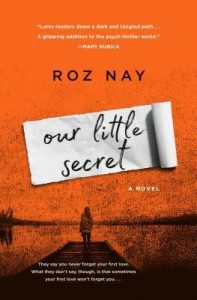 This story opens in an interrogation room, with Angela prepared to tell her story to police, if they will only listen. Finally, Detective Novak allows her to share everything that she feels is relevant, beginning with her meeting H.P. in high school, where he changed her life. They became best friends who fell in love, or as Angela tells the story, soul mates. She leads Detective Novak through their complicated relationship, hampered by her lack of a healthy role model and his small town contentment, and further strained by Angela attending Oxford, where she’s befriended by Freddy, who dotes on her against her will. Detective Novak perks up at the entrance of Saskia, the missing wife, the reason for Angela’s interrogation, during H.P.’s visit to England. Misunderstandings ensue, emotions tangle, and new pathways are formed. Angela blames losing her first love on everyone else, spending her life from that point on waiting for him to do the right thing. When her mother moves in uninvited after leaving her father, she pursues an unhealthy friendship with H.P. as their houseguest and babysitter, which culminates in Saskia’s disappearance. Detective Novak pieces together the evidence through the long night of storytelling by Angela, who is either also an innocent victim or a truly unreliable narrator.
Nay leads the reader through a maze of Angela’s fears, internal struggles, unrealistic desires, and inevitable disappointments. Angela is brilliantly depicted as a minor character in her own life, for which she can then lay guilt at whoever she allowed to make the decisions for her, as she waits in vain for things to go her way without taking action herself. Failure to communicate is a key element in the derailment of Angela’s life, and Nay relays every misstep taken by those underestimating her. The ending is not as well captured as the entire novel leading up to it, subtlety left behind in the previous chapter.
I was fortunate to receive an early copy from the publisher through a giveaway.