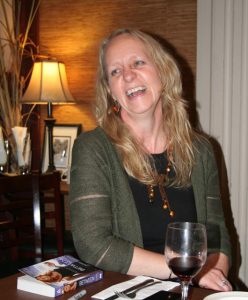
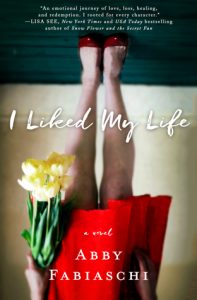
I decided that I sincerely want my debut novel published by St. Martin’s Press, since most of my favorite authors are with them. This is how I came to read Abby Fabiaschi’s debut novel I Liked My Life and I loved it (see my review), so reached out to her to let her know. She is so friendly that I asked her for an interview for my little blogblogblog and she agreed!
Turns out she’s also an activist for survivors of human trafficking, which is amazing and will be addressed at the end of this interview. She is a survivor herself of a dog attack at a young age, which altered her life and perspective, as you can read below in the Author Extra.
Tell me your artistic / writing process, including schedule, environment, and inspirations.
Motherhood really changed the answer to this question. I use to be able to be much more picky! I put in a minimum of five hours a day—usually 3-4 while the kids are at school and 1-2 after they are asleep (or at least I think they are). I work in a home office at a desk…boring, I know. I’m inspired by whatever it is I’m exploring. I don’t start my stories with an end in mind, so characters’ experiences keep me vested and learning with them.
Walk me through your publishing process, from final draft to final product, including your publishing team.
Right now I’m with St. Martin’s. When a first draft is complete, I send it to my agent and editor. They pile on constructive feedback and I make a plan for a round of revisions. That step repeats itself until we all say, “Yep. This works!” St. Martin’s decides on a release date at least a year out and designs a cover. From there, the assigned publicity team works on getting Advanced Reader Copies in the right hands while I get back to work on the next project. About six months before the launch, I get to review the final pass, which is when I add in acknowledgements.
Talk about your support system, including beta readers and all of your cheerleaders!
I am in awe of amazing people like you, who bring reading and writing communities together. Since my debut came out, I’ve also been grateful to establish friendships with many talented writers, including all the wonderful authors in The Tall Poppies. (If you are a reader on Facebook, follow Bloom with Tall Poppy Writers—great content and giveaways!)
I don’t have a writing group, nor do I leverage a ton of beta readers. Rather, I approach a couple people who I think would offer a valuable lens on the story to be first readers. There is one exception—my sister is always on the list!
How does life influence your art and vice versa?
Each story I write sets out to explore a component, a strand, of either something I’ve witnessed or experienced. I get a moment in my head and my mind runs with it—what if this and what if that?—until a set of characters have lived through a moment worthy of readers’ time.
What do you love most about your creativity?
I love how I learn from my characters. With I Liked My Life, I came to believe that even life’s most antagonizing moments offer slivers of beauty once you rise above the fog and the haze of grief. There’s insight and clarity there for the taking. Now, it’s at the expense of whatever you lost and it will never be worth it, so you have to learn to digest the injustice of that. It’s a conclusion I never would have gotten to without diving into the Starling’s story.
Please share about your advocacy activism—I’m all for telling everyone the good you do in the world!
I’d love to! Twenty percent of all of my after tax proceeds go to an organization I co-founded called Empower Her Network. We collaborate with ready survivors of human trafficking who find themselves in the same vulnerable circumstance that led to their initial exploitation by removing housing barriers, financing education, and uncovering employment opportunities. To learn more or buy a Lulu Frost Empowerment bracelet, go to www.empowerhernetwork.org.

Follow Abby
Author Extra: The Inspiration for Abby Fabiaschi’s I Liked My Life
I was attacked by a Rottweiler when I was nine. The last stitch on either side of the wound was inside each eyelid. The dog, aptly named Gator, missed both my eyes by an amount so small as to be immeasurable. The ER doctor heralded this a miracle and I decided, right then, that no matter what I looked like the next day, I would focus on that piece of good fortune—I could still see.
What I didn’t understand in my then-scarred state was that what I would see was about to change. I became a person worthy of double-takes and gasps. I was forced to acknowledge a truth far younger than most; it doesn’t matter what you look like, at least to some. I got fifty-seven stitches that first night and eight reconstructive surgeries over the twelve years that followed, but his is not a sob story. Yes, bone from my rib is now on my nose, and skin from behind my ears and on my ass is now on my face, but I wouldn’t take back that night if I could.
Because here’s the thing—I don’t know who I would be without that experience. Those scars brought me perspective at a young age. They made me tough. They gave me loads of time to read where I could sop up the crazy mistakes people make without experiencing the consequences. They protected me from vanity and made me a keen observer, ultimately leading me to writing.
A friend recently commented that life has thrown enough complications my way to merit a memoir, but an exceptional memoir requires you to hand over the whole of your truth, along with your version of other peoples’ truth, and I’m too territorial for that. Still, I borrow here and there.
When I was fifteen, I lost one of my closest friends in a tragic car accident. I felt tremendous guilt because I hadn’t invited Elizabeth over that day. So stupid—we liked the same boy, so I excluded her. Introducing guilt and grief to my already raging teenage hormones and fierce desire for independence was a hugely defining moment in my life. I Liked My Life started with a desire to explore mourning at that tender age. I wrote it for me, and then went back to my demanding career in high-tech.
Four years later, at fifty-three years-of-age, my dad died of a heart attack. He was my father, but he was also my boss, mentor, and best friend. I didn’t write for years after his death, not even in a journal. The loss consumed all of me.
Then one day, I happened across I Liked My Life on my computer. The title popped from the screen; it felt enormously important to revisit it. Having then mourned as a teenager and a parent, I was better able to distinguish the nuances of grief experienced by each character. Tapping into those challenging life events is where the nonfiction ended and the storytelling began. I was inspired by a sentiment from Adrienne Rich’s poetry; If we could learn to learn from pain even as it grasps us. Isn’t that a powerful thought?
As I discovered after the dog bite, slivers of beauty exist in life’s most antagonizing moments, if only you know where to look. I set out with three characters—Madeline, Eve, and Brady—as they learn exactly that, each on their own timeline and in their own way. I wrote the book for me, unburdening my loss on unsuspecting characters. That their journey will find its way to living and breathing readers is wild.
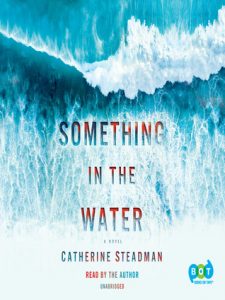 Erin’s fiancee loses his investment banking job just before they marry, causing ripples throughout the wedding planning due to his loss of income. They go ahead and hold the big wedding and go on their intended honeymoon in Tahiti, keeping their hopes up for his future employment. While scuba-diving on honeymoon, they discover a plane wreck in the ocean. A more experienced scuba diver, Erin’s new husband Mark retrieves a dufflebag of money from the wreckage. Despite good intentions, they end up smuggling it home where they begin an ongoing debate on what to do with it, even as they hide it in their home. Mark seeks opportunities while Erin continues her documentary on the before and after of three convicts released from prison: a young girl who turns to terrorism, a middle-aged woman who helped her terminally-ill mother die with dignity, and a professional criminal.
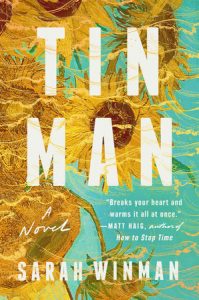 Ellis and Michael begin a lifelong friendship after Michael’s mother dies and he comes to live with his grandmother Mabel, both boys sharing the affection of Mabel and Ellis’ mother Dora. The delicacy of their first love romance shatters as Ellis yields to society’s mores after a turning point in France, and even Michael understands that Annie is “the one.” Loving Annie draws Michael into their orbit, expanding her idea of family to include him and his grandmother. Although readers are familiar with the horrific stories of gay men succumbing to AIDS, Winman carefully portrays Michael’s unique perspective on his friends’ deaths—he returns to France where he grieves for all that he’s lost in his life. The first half of the book focuses on Ellis after all of his losses leave him off-kilter, wondering what to do with himself. The second half flashes back through Michael’s journals, a candid look at a man whose fulfilled expectations disappoint. This is a gorgeous story of how love grows to include those who might be estranged by circumstances. I was fortunate to receive a copy through a Goodreads giveaway.
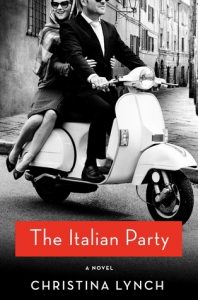 Scottie married Michael and they moved to Siena, Italy, both bringing secrets and gathering more, so that they appear to be a happily married couple, he selling American tractors to Italians and she his adoring housewife. Showing Italians the American Dream fulfills a larger agenda for Michael, while Scottie tries to look behind the curtain and see his true self. She seems to have a lot more freedom than expected for a woman in the mid-50s, and Italian men are portrayed as oversexed political creatures. Homosexuality is handled in a sensitive, if somewhat stereotypical, manner considering the times—adultery is inexplicably given more tolerance. When the couple open up and confess all, they become a team, and Michael learns that political secrets are larger than his own agenda, gobsmacked by his own company. This is a great historical fiction, with Siennese culture, the fallout from being overshadowed by Florence, and the political turmoil of Communism versus pro-Western leaders vividly portrayed. It shows the complexities of the world players’ motives and relationships, and how this plays out in the individual lives of the Italian people.

 Tell me about your support system: beta readers, publishing team, and any other cheerleaders.
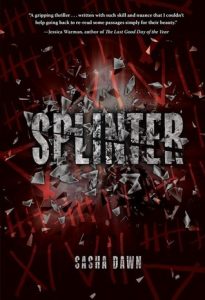 Take me through your publishing process, from final draft to published product.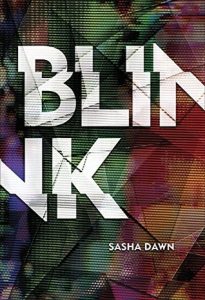

 The diversity in these stories is impressive, from girls facing internal and external religious challenges, to girls pretending to be something they’re not to make their way in a man’s world. These are tales of young women refusing to be a product of their time, yearning to be free of society’s mores. The authors refrain from a black and white picture, with a young Mormon girl questioning her religion, yet continuing to fight her community’s detractors. Secrets abound, as an orphaned girl lives life as a boy to take care of herself, and a young boy trades his secret of being a transgender with a Hispanic girl putting in tremendous effort to pass as white for Hollywood. One story had magical elements that didn’t seem to contribute to the plot, but as a whole, this book offers up a dozen girls as unintentional heroines who fought against patriarchy, misogyny, and other obstacles they intended to overcome.
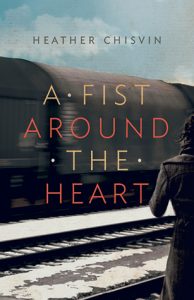 Anna “Bencke” Grieve’s life changed after Tsar Alexander II’s assassination. In fear for their lives as Jews, her mother, a privileged servant, asked her employers Count and Countess Chernovski to take Bencke and her older sister Esther with them to Canada. The Chernovski’s later adopt them, believing their parents to be dead. Bencke does her best to care for Esther, who suffers episodes from traumatic memories that incapacitate her at times, as she herself tries to fit her eccentric personality into Countess Chernovski’s picture perfect household. Decades later, Anna receives a phone call from the Winnipeg police informing her that her sister has committed suicide by stepping in front of a train. She heads to Canada seeking the truth. The story alternates between this investigation and a backstory of a life fully lived, from Anna’s forced relocation to NYC, to circumstances causing her to be deported to Russia during WWI. In the investigation, Anna learns her sister’s secrets and must live with them now.
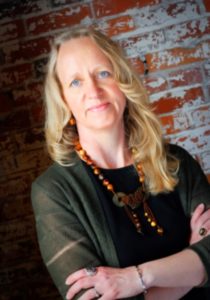 I
I follow
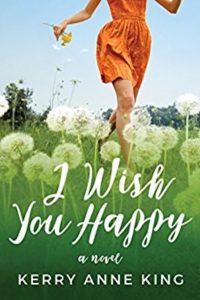 s Kerry Schafer I write fantasy and paranormal thrillers. As Kerry Anne King I write contemporary family dramas (although the book I’m writing now does have a touch of magical realism that makes my fantasy-loving-heart happy). Keeping track is fairly straight forward—Kerry leans to the dark side; Kerry Anne leans toward relationships and emotions.