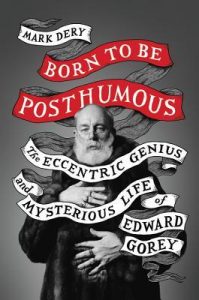
 Mark promoted his Edward Gorey biography Born to Be Posthumous on Twitter and I politely asked for a copy to review. He graciously offered publisher contact information, and Little, Brown, & Company sent me a copy. It’s so good, people. If you’re not familiar with Gorey’s work, you will want to be in on this open secret after reading Dery’s book. Gorey was a fascinating character, and Dery is a brilliant storyteller. He’s really so much more—this interview a tiny peek into the profundity of his work, but I’ll let you read up on Mark further on his own website. Links to connect with Mark and purchase his work follow the interview.
 Tell me about your writing process: schedule, environment, strategies, inspirations intangible and material, magic spells, etc.
I rise at the crack of noon, as Christopher Hitchens liked to say, and lower myself into a vat of virgins’ blood in strict adherence to Elizabeth Báthory’s beauty regimen for eternal youth. After a rejuvenating soak, I trim the topiary; then spend the morning in bed, languidly leafing through the Encyclopedia of Unimaginable Customs and nibbling candied violets.
But seriously: I have no set schedule unless I’m on assignment—working on a lecture, knocking off a piece of journalism, or writing a book, as I have been for the past seven years.
My “environment”—why am I thinking of a hermit crab in a terrarium?—is a small office in the attic of my house, a worse-for-wear 1868 Victorian in New York’s Lower Hudson Valley. It’s the proverbial garret, snug as a fo’c’sle, or what I imagine a fo’c’sle would feel like, based on second-grade memories of books about pirates and whaling. On top of one of my bookshelves is what I like to call my aesthete’s altar, a poor man’s cabinet of curiosities: a pickled Jerusalem Cricket floating in formalin, a desiccated Tarantula Hawk, postcards of my pantheon of secular saints—E.A. Poe, Oscar Wilde—and of images from my personal symbology (Watson and the Shark by John Singleton Copley, that Diane Arbus photo of identical twins) and, for crowning effect, two human skulls. Which makes it sound more romantic than it is: the paint on the walls nearest my desk is scabrous; teetering stacks of whatever books I’m using for my research are heaped on every available surface, including the floor surrounding my desk, which makes the passage from desk to door tricky at best and perilous at worst. When I’m in the death throes of an essay or a book chapter, things can get seriously out of hand, with xeroxes of articles and books propped open to specific pages threatening to avalanche off my desk, which they often do. Inspiration? That comes from the subject at hand, whatever it is, but if inspiration is lacking, a heart-hammering cup of Bustelo—three scoops of espresso made in my battle-tested Bialetti Moka—never fails to beckon the muse. I’m one of those writers who listens to music while he works, instrumental only (words are too distracting), preferably something that suits the mood of whatever I’m working on, though not necessarily in a strictly literal way. For Gorey, that could be anything from Morton Feldman to Jóhann Jóhannsson’s soundtrack for Arrival to György Ligeti’s “Études for Piano” to No Pussyfooting by Fripp and Eno. By five o’clock, I’ve had two pots of Bustelo and need to chase the evil spirits out of my head. A bike ride or a run along the tree-lined streets at the woodsier end of town are just what the doctor ordered; deer are everywhere, browsing on suburban shrubs, and the trees look uncanny in the oncoming twilight, branches clawing at the sky. (My iPhone is full of photos of trees that look like something out of Algernon Blackwood’s gothic tales of haunted forests.) Then it’s home for dinner, typically spent yelling at cable news, then back to my lair for a few hundred more hard-won words, with a glass of shiraz to downshift after my heavily caffeinated day.
 How do you choose your subjects?
They choose me. I have the attention span of a gnat, which is good for the mind but bad for the wallet, since hoeing the same row is more lucrative than being an intellectual flâneur. One subject leads me to another, through some combination of serendipity and free-association. In an age of hyperspecialization, being a generalist isn’t a recipe for success but the idea of fitting your mind to a monorail seems like living death. I had a colleague once, a journalism pundit, who told an interviewer (with suitable portentousness), “I get up every day and ask myself one question: What are journalists for?” Just shoot me, I thought.
 Talk about your support system online and IRL; what motivates you? Who are your biggest cheerleaders?
In all honesty, I don’t look for support, at least not in the sense you seem to mean—a kind of validation. Do most writers? I suspect not. Writers write not because they want to write but because they must; it’s not what they do but who they are. Certainly, fan mail is balm to the soul, not to mention a bracing antidote to that nasty review that made you want to inch out onto the window ledge—or drop a cornice on the offending critic. That said, I write for The Ideal Reader, a vaguely defined apparition who should never be brought into sharp focus but who bears a striking resemblance, I have a sneaking suspicion, to the face in the shaving mirror. Few writers admit it, but most write for themselves. Of course, you have to divide yourself by The Other—your wider audience—to save yourself from a fatal self-indulgence, not to mention abject poverty, which is where editors are very writer’s saving grace. Mine, Michael Szczerban at Little, Brown, saved me from a million little misdemeanors and a few Class A felonies in my Gorey biography. Writing is a communicative act, to be sure, unless you’re writing a diary, the point of which has always eluded me: there’s no paycheck, and no applause. At the same time, a good writer is his own severest critic and thus his most honest reader—maybe not the only support system he needs, but certainly the linchpin of the thing. As Lou Reed snarls in his onstage rant, on Take No Prisoners, about the rock critic John Rockwell, “I don’t need you to tell me that I’m good.”
 As a writer and public speaker, how does your life influence your work and vice versa?
It doesn’t. Lecturing is to writing as improvisation is to composing, I suppose. I speak from written texts but, in the run-up to my talk, annotate them with frantically scribbled marginalia, jotted notes for fruitful digressions inspired by keywords in the text. They’re a kind of musical notation, indicating where to wander off into the weeds and when to double back to the main arc of the argument or narrative. Sometimes, ideas generated in this manner will find their way into a revised version of the essay or book chapter or whatever it is; so, too, will comments and questions from the audience. But I’m enough of a control freak that I almost never speak completely extempore. At the same time, I’d never think of just reading my text, as academics tend to; it’s pure chloroform, calculated to send the audience streaming to the exits in the first 10 minutes!
 What do you love most about your creativity?
That it opens the door to The Marvelous, as the surrealists called it. As a practicing surrealist, I’m always on the lookout for The Marvelous—the uncanny, the fantastic, the utterly alien lurking just around the corner, hidden in the everyday, but only revealed when seen from a certain angle. Gorey was fond of quoting two quotes that were, he said, at the heart of his worldview. One of them was from the surrealist poet Paul Éluard: “There is another world but it is this one.” The other was from the Oulipo author Raymond Queneau: “Things aren’t as they seem, but they aren’t anything else, either” (or words to that effect). Where those two realities flow together is where I fish, as a writer.
 Connect with Mark:
website
Twitter
Amazon
Goodreads
The Daily Beast
Hyperallergic
Thought Catalog
boing boing
 Marietta left Kentucky after high school, changed her name to Taylor, and become a mother through an unexpected incident, ending up in Tucson with a single mother roommate and a job as a tire mechanic for a woman who rescues undocumented immigrants. Selectively mute from obvious chronic abuse, her newly acquired daughter Turtle learns to trust Taylor, who learns to trust in her new friendships as she seeks a way to keep Turtle legally and build their life in Tucson.
 Lily loves Charlie more than any other human, for he rescued her when other potential adopters frowned at her limp. She’d been abused by her previous owner and her broken leg healed without veterinarian intervention. Now he’s being bullied and Lily must figure out a way to help him amid the chaos of Dad’s drinking, Mom’s sadness, his sister’s possible suspect boyfriend, and his big brother’s anger. The unique perspective of a cat gives readers a view from inside the family, but with a pure, some might say naive, but definitely less than jaded, outlook. Lily can be as surprised as a person by such things as Charlie’s choice of “mate” being another boy. Ward’s representation of a gender-fluid, gay teenager comes across as natural and inclusive, even as she shows the challenges he must face, especially from his own family. His mother and sister’s acceptance counter his father’s confusion and his brother’s resistance. Of course there’s a romantic interest for mom, who’s separated from dad and planning divorce. However, he immediately touches her intimately and insinuates himself into family issues, coming across as a bit creepy rather than romantic—too much too soon. This is the only part of the story that doesn’t flow organically, a small distraction. This story presents multiple serious subjects that are handled with compassion: alcoholism, addiction, chronic pain, divorce, and gender expectations. Ward takes her family down a path of resolution surprising, yet realistic. Readers who love main characters off the beaten path will appreciate this story; animal lovers will be vindicated.
 This book is more than expected, with historical references, how gardening has morphed into a recreational activity in our industrial age, advances in gardening—for sustenance and pleasure, and a chronology of gardening literature. It’s about far more than planting, encompassing various philosophies and exploring gardening throughout fiction and non-fiction. I was fortunate to receive this wonderful book about the practicalities, aesthetics, and dreams of gardening from the publisher through NetGalley.
 This collection opens with a tale so convincing dear reader will be googling Count Darlotsoff of the Russian Revolution. Roorbach’s stories ramble along pleasantly, with wit and wisdom, from a unique perspective. Then BOOM! Something astonishing happens, sometimes indicated by a simple line, “And fell into a basement hole,” and sometimes portraying a much larger concept, such as patricide. The tales delve into history—the aforementioned Russian Revolution; plunges deep into socio-political culture—“His father was an important king or chieftain in an area of central Africa he refused to call a country, an area upon which the Belgians and several other European powers had long imposed borders and were now instituting ‘native’ parliaments before departing per treaty after generations of brutal occupation;” and parses human emotions and relationship dynamics—“sharks unto minnows.” There’s even a ghost story, with elements of land conservation, familial squabbles, and burgeoning love. As diverse as the themes are, and as broad the representation of people, one story stands out for its LGBT ignorance, as a main character tells the benefactor of her theater, a widower asking for a kiss, “Marcia had politely allowed just one, then explained that while being a lesbian might not mean she was entirely unavailable, her long-term relationship did.” He then proceeds to win over her wife, and they merrily cavort about town, all three holding hands, doing everything as a threesome. Lesbian relationships are real relationships, and lesbians are not toys for a man’s pleasure. That being said, this is a blemish on a set of otherwise fascinating and weird and brilliant stories. The book is dedicated to Jim Harrison, whose fans will likely appreciate Roorbach’s work.