 Steve Carr’s first collection of short stories is fantastic. His work is intense, reaching into the reader’s head and twisting emotions, shattering logic and reason. The first story Tenderloin is—pun intended—a punch in the gut, as the reader sees the grittiness of the setting and feels the coiled tension in the main character, a veteran of the Iraq War. With journalistic expertise, Carr displays monstrous humanity in a brevity of words, as in The Saguaro Two Step, in which the woman wins the loot in the end, and exposes desperation, as in The Festival of The Cull, wherein Shamina can no longer vote on who is to be terminated. Reality bends as one ventures further into the book, as in the self-explanatory The Girl in a Mason Jar, gets fishy in Strange Water, and disappears in When Wizards Sing, where animals and men blend. The stories are diverse, with main characters of various genders, sexual orientations, ages, cultures, and even species. The book ends with stories of the afterlife on a never-ending train ride for incorrigibles, a man’s struggle for gravity, and the misplaced hope of a senior citizen. Definitely a must-read! Follow Steve on Facebook and Twitter. Purchase Sand at Lulu.com or Amazon.com.
Category Archives: Books Books Books
Echo Moon (Ghost Gifts #3) by my favorite ghost writer Laura Spinella
 Echo Moon finishes the Ghost Gifts trilogy, beginning with Aubrey and her souvenirs from ghosts she helps that she calls “ghost gifts,” through her marriage to journalist Levi St. John, to their son’s story of his past life, wherein he envisions shooting his true love Esmerelda Moon—Esme. Spinella pulls the reader into an early 20th-century culture of supper clubs and amusement parks, showcasing Luna Park of Coney Island, with its rides, performers and customers. We even witness the shadier “rides,” “performers,” and “customers” of the Elephant Hotel, a brothel set on the edge of the park. The hotel is real, but turned brothel after the heyday of the family-oriented park, and pulls Spinella’s story into the historical fiction genre as she carefully blends it into her novel.
In Ghost Gifts, Aubrey solves the mystery of Missy Flannigan’s decades old, cold-case murder with a recalcitrant Levi St. John, and they reluctantly fall for each other. In Foretold (Ghost Gifts #2), Aubrey and Levi are raising their son Pete, who suffers nightmares that are actually visions of his previous life as a photojournalist in WWI. The investigation of a John Doe (who turns out to be Aubrey’s friend Zeke) murder in which Levi is assisting culminates in the kidnapping of Pete, who is of course rescued by his parents. In Echo Moon, Pete finally solves the murder of Esme, with the help of Zeke’s niece Emerald—Em. Spinella spins coincidences into relevant evidence and drops the solution out of nowhere, but it all makes perfect sense. She has a way of surprising the reader without making the reader feel dumb for missing clues, and her characters are colorful and complex.
I received an early copy of Echo Moon from the publisher in a giveaway. Thank you, Laura! I love it! Visit her website to follow her on social media and purchase her books. Tell me a personal experience with the paranormal in the comments, and I’ll choose a random winner to send my ARC of Echo Moon!
The Gods of Howl Mountain by Taylor Brown
Secrets are Held Closely in the Mountains
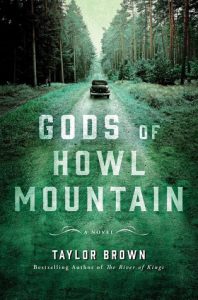
Granny May Docherty lost her daughter Bonni to Dix Hill 30 years ago when nightriders killed her boyfriend, the mill owner’s son Conner, silencing her voice. Her grandson Rory lost his leg to Korea, limiting his employment opportunities on his return home, leaving him little choice but to become a whiskey runner for Eustace Uptree, his best friend’s uncle and Granny May’s lover. Brown takes readers through the rabbit hole away from Mad Men and the American dream of a white picket fence to the colorful and dangerous world of Appalachia, where reigned illegal whiskey and wannabe drivers for the newly founded NASCAR.
A middle-aged wood witch and former prostitute, Granny May longs to know who hurt her girl, but fear of consequences prevents her from pursuing it with Rory. Brown’s subtle backstory of Bonni and Conner’s romance contrasts with the rawness and graphic depiction of mountain life in the 50s. Flooding of mountain valleys for “progress” disrupted Appalachian culture and forced a reluctant relationship with those living in towns and cities. Amy Greene’s “Long Man” shows the resistance of one woman against such flooding by the government. In Brown’s story, the event is long-reaching, since the main road literally heads straight into the man-made lake. As in Amy Greene’s debut novel “Bloodroot,” a body part is used as symbolism of a South yet alive with Pagan ways while tightly holding its secrets.
Taylor Brown digs out niches in his historical fiction—last vestiges of whiskey runners and nascent NASCAR, river kings, the lawlessness at the end of the civil war—getting down to the nitty-gritty of hard-living, developing complex characters who maintain their integrity in impossible situations. He gets a bit too “real” sometimes; for instance, there’s a lot of spitting in this book, some of it from Granny May—so much spitting. In one scene, Eustace flicks his nephew in the nuts. Graphic details can overwhelm the reader, such as when Rory’s rival purposely hits a deer and Brown describes the specifics of the deer’s physical suffering. Having said that, the reader leaves the novel with a sense of having learned history not found in textbooks, such as exactly what someone who drives illegal booze through the mountains does to his car to outrun the revenuers. It’s a definite must-read.
Sisterly by Jorja DuPont Oliva

Janie returns to her hometown to make things right with her sister, and her ex-boyfriend who married her sister, by revealing her secret to them. She stays in the yellow house run by Mrs. Francis, where the otherworldly seems to creep in, everything is too connected for reality, and Mrs. Francis forbids her to enter the mysterious, yet beckoning, backyard. Though the dialogue is stiff—no contractions are used, and can sound unrealistic—Mrs. Francis’ dialect is over the top, the characters’ interactions with each other and Janie’s “episodes” are vivid. When Janie’s missing time and chaotic, dreamlike events are explained in the final scenes, the brilliance of Oliva’s storytelling skills burst forth like fireworks. Though hints are sprinkled like candy throughout the story, the reveal is surprising, and the reader can only be impressed by the descriptive details and timeliness of those “episodes.” References to the inciting incidents are well placed in the story, with emphasis in the reveal for a satisfying ending.
The author offered this novel gratis in March and I was fortunate to pick it up and read it, posting a review for the book gift and for my delight in the story. Thank you, Jorja!
The Little French Bistro by Nina George
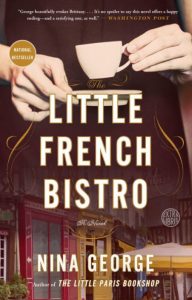 Finding Femininity and Feminism in France
“Does love have to be earned through suffering?”
Marianne determines that the Seine is preferable to one more minute of accommodating her husband’s controlling condescension. She walks away from the tour group during dinner to dive into the river, and her husband does not even notice her leaving. A homeless man “steals her death” by pulling her from the water. In the hospital, her husband expresses his concern that her attempt affects him adversely. She again walks away, bent on reaching Kerduc, the seaside town depicted in the nurse’s placemat tile, a town in which she invests her romantic notions of a larger death than her life has been. Circumstances lead her there as if by magic, pulling her into a setting amongst colorful, complicated characters that could have been created by Maeve Binchy. She falls into employment at Ar Mor restaurant, fitting seamlessly into the rhythms of the kitchen. At 60, Marianne begins a new life, of wonder, of real love, of authenticity. Toward the end, the novel gets a bit over the top (with the young waitress Laurine inexplicably removing all her clothing to rescue Jean-Remy’s love letter boats from the water, but maybe that one’s a French thing), yet maintains the integrity of its characters and Breton setting. A woman blooming into a fully realized individual after decades of being an extension of her spouse evokes feminism, when she can see herself as an equal to her lover.
Brittany, France, stands proud as a character in this story, new friends emphasizing Breton identity and sharing Breton folklore. Marieanne’s mysterious introduction to the community as “the woman who came from the sea” invokes the legend of Ys, the city swallowed by the sea, and her new love takes her to the magical forest of Broceliande. Although German, Marianne feels at home amongst her new friend, from the little touches, such as her return to playing the accordion, a long-stored instrument given to her by a Breton reluctant to fall for her charms based on memories of the war. She discovers that there are various ways to thwart love and defy romance. In another nod to Maeve Binchy, the ending provides closure without complete resolution, as in real life. There is death, rekindled romance, illness, love rescued, dementia, and new life, with all their complex and tangled emotions.
International bestselling author Nina George, after “The Little Paris Bookshop” (translated into 35 languages), again lays out beautiful, complicated relationships in seemingly impossible situations and offers readers wildly emotional connections and absolution as human beings in “The Little French Bistro,” on its way to multiple translations.
I was fortunate to receive a copy of this wonderful book through NetGalley.
Our Little Secret by Roz Nay—pub date April 17, 2018
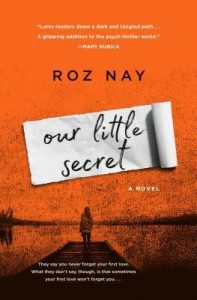 This story opens in an interrogation room, with Angela prepared to tell her story to police, if they will only listen. Finally, Detective Novak allows her to share everything that she feels is relevant, beginning with her meeting H.P. in high school, where he changed her life. They became best friends who fell in love, or as Angela tells the story, soul mates. She leads Detective Novak through their complicated relationship, hampered by her lack of a healthy role model and his small town contentment, and further strained by Angela attending Oxford, where she’s befriended by Freddy, who dotes on her against her will. Detective Novak perks up at the entrance of Saskia, the missing wife, the reason for Angela’s interrogation, during H.P.’s visit to England. Misunderstandings ensue, emotions tangle, and new pathways are formed. Angela blames losing her first love on everyone else, spending her life from that point on waiting for him to do the right thing. When her mother moves in uninvited after leaving her father, she pursues an unhealthy friendship with H.P. as their houseguest and babysitter, which culminates in Saskia’s disappearance. Detective Novak pieces together the evidence through the long night of storytelling by Angela, who is either also an innocent victim or a truly unreliable narrator.
Nay leads the reader through a maze of Angela’s fears, internal struggles, unrealistic desires, and inevitable disappointments. Angela is brilliantly depicted as a minor character in her own life, for which she can then lay guilt at whoever she allowed to make the decisions for her, as she waits in vain for things to go her way without taking action herself. Failure to communicate is a key element in the derailment of Angela’s life, and Nay relays every misstep taken by those underestimating her. The ending is not as well captured as the entire novel leading up to it, subtlety left behind in the previous chapter.
I was fortunate to receive an early copy from the publisher through a giveaway.
Memories of My Future by Ammar Habib and Anil Sinha
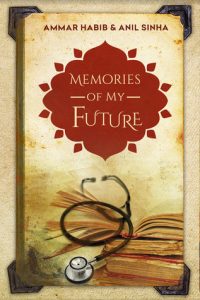 Surgeon Avinash Singh loses a child during surgery to heart failure caused by a new virus. Having accepted always being the best at everything he does, this harsh reality devastates him. His nurse Martha, a second mother in his adopted country, tells him to find a way to deal with it and get back to work. He seeks resolution in the journal of his ancestry given to him by his grandfather. He reads of Khau, the Lion of Bihar, a 13th-century warrior ancestor, who must find a way to save Bihar from the Mongols. Those barbarians destroy everything in their path, because they are unbeatable archers on horseback. Khau determines their weakness and defeats them. The inspirational story motivates Avinash to develop a cure. From this breakthrough, Avinash receives two offers: a position at a coveted medical center in NYC and a chance to offer his skills to a humanitarian effort. He returns to the journal to learn about Veeresh, the leader of his people who did not break under torture by the East India Company’s best “negotiator.” From this lesson, Avi knows he must follow his heart. On this path, he finds true love and faces a challenge that calls out to his warrior blood.
This historical fiction carries more than one lesson within it’s dual timeline. It reads like folklore with a moral to the story. Told alternately through the contemporary life of a brilliant surgeon and a journal of his ancestry, it weaves from one to the other seamlessly. The authors repeatedly mention the diversity of religions in the stories of Avi and his ancestors, and they use the different religious lingo interchangeably to emphasize tolerance. The main takeaway seems to be, however, that you should be yourself and keep moving forward in service to others, using your god-given talents without fear.
I received a digital copy of this wonderful story from one of the authors.
After Anna by Lisa Scottoline—pub date April 10, 2018
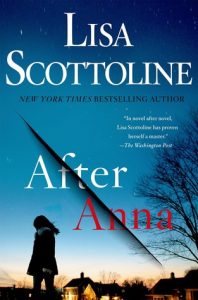 Dr. Noah Alderman is on trial for his life, accused of murdering his stepdaughter. Her father fought ruthlessly for custody of baby Anna as a power play after Maggie suffered the relatively unknown, but common, postpartum psychosis. With his recent death, Anna reaches out to the mother she wants to know. She enters the family, which includes Noah’s 10-year-old son Caleb, with a fortune from her father and an attitude of entitlement. Her accusations of molestation against Noah rend Maggie’s heart. Though circumstantial evidence points to Noah as Anna’s killer, Maggie retains a sliver of hope, not quite able to believe he is capable of such an atrocity. A phone call with shocking news sets Maggie on an investigation that may possibly free Noah and return him to her.
Told in alternating timelines, moving back in time through Noah’s trial, while Maggie’s story moves forward from the initial contact with Anna, the stories come together after the trial, with the reader learning information along with the characters. In true Scottoline fashion, the reader is kept guessing who did what until the perspective-shifting bombshell, and the action fast forwards. Un-put-down-able!
I received a digital ARC through NetGalley of this fantastic novel from one of my favorite authors.
Hour Glass by Michelle Rene
 The pa of the Glass children, Jimmy and Flower, dies of smallpox in a pestilent tent hospital in Deadwood, South Dakota. They had pulled him into town from their shack on his gold claim, proving their mettle. Madame Dora DuFran takes charge, and Calamity Jane, who’d followed Wild Bill Hickok to Deadwood, works in the pest tent, caring for their pa, watching him slowly fade. Jimmy and Flower, who goes by Hour, sleep in DuFran’s storage room, which previously housed Jane, who prefers to sleep off her routine drunks outside under the stars, anyway. Hour’s mom, a Lakota, visits Jimmy in his dreams to offer wisdom as he confronts challenges (one of which is first love) in their few weeks at DuFran’s brothel, until their pa passes. Jane holds a fundraiser for her “daughter” Hour’s education, receiving enough to send both children to a convent school, giving them a good start in life. Jimmy channels Jane in a life of constant travel, but Hour marries and raises a family in Kansas City. While working as a storyteller in the Buffalo Bill Wild West Show, Jane meets up with Jimmy and they catch each other up on their lives. Jimmy sees her only once more, in a small town where she was put off the train, at a hotel on her deathbed. The happily ever after comes to Jimmy when his first love finally leaves prostitution for marriage.
This is an interesting view of Calamity Jane’s life, from the perspective of a child she and Dora DuFran rescued. Rene kept the integrity of a pre-teen boy’s point of view, while filling the cast of characters with real life colleagues of Jane: Wild Bill, Dora DuFran, Charlie Utter, and a passing reference to Buffalo Bill. A fictionalized account of Calamity Jane is likely more appropriate than a biography, as her tall tales live on. Rene gave a noble account of the fundraiser given for Jane’s “daughter,” interspersed her best tall tales throughout the story, and followed the chronology of Jane’s life that is accepted as true, or the truest. It’s a raucous story, such as Jane’s own life.
I was fortunate to receive a digital copy through NetGalley.
Coffin Scarcely Used by Colin Watson
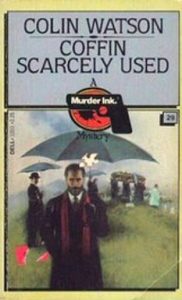 Councillor Harold Carobleat has died, having succumbed to a lingering illness. Soon after, his neighbor and solicitor are found dead under mysterious circumstances. As both are colleagues of Carobleat, and one suspected to be intimate with Carobleat’s wife, Inspector Purbright investigates Harold’s passing as a possible murder as well, eventually connecting it all to a shady business deal.
Often throughout the story, complicated sentences obstruct meaning just as characters obstruct justice in their attempts to thwart Inspector Purbright. It’s worth it in the end, though. The last line is killer!
I received this delightful cozy mystery through NetGalley.