Anna Roux’s life changed drastically when her husband moved them from Paris to the American Midwest. Her profession as a dancer fades to history, and she disappears inside herself, despair manifesting as anorexia. In a holiday visit home, her family’s shocked reaction to her appearance prompts her husband to commit her to a strict program at 17 Swann Street, where Anna learns the hard way to eat again. There’s so much more going on than Anna feeling fat, so much involved in succumbing to an insidious disease. Zgheib carefully maneuvers through the complexity of her character’s inner turmoil. As a contributing factor as well as an integral part of Anna’s support system, her husband is explored through his emotional roller coaster, denial, and finally, tough love response to her illness.
This story paints a detailed description of a unique life with an unfortunately common disease, where one cannot point to any one action as a causation. Readers with no connection to this illness still will reel from the pain of a young woman who feels out of control of her own life, who cannot reconcile her less than desirable circumstances with the love she feels for her husband, sympathizing with her as she is forced to confront the voice of anorexia telling her that she is not enough. The slow, challenging journey is well told by a talented writer. This is a must-read for the awareness and understanding it brings. If anorexia has touched your life in any way, offer this story to friends and family. Even if it hasn’t, read and share for the compassion invoked.

Yara Zgheib’s poetic and poignant debut novel is a haunting portrait of a young woman’s struggle with anorexia on an intimate journey to reclaim her life.
The chocolate went first, then the cheese, the fries, the ice cream. The bread was more difficult, but if she could just lose a little more weight, perhaps she would make the soloists’ list. Perhaps if she were lighter, danced better, tried harder, she would be good enough. Perhaps if she just ran for one more mile, lost just one more pound.
Anna Roux was a professional dancer who followed the man of her dreams from Paris to Missouri. There, alone with her biggest fears—imperfection, failure, loneliness—she spirals down anorexia and depression till she weighs a mere eighty-eight pounds. Forced to seek treatment, she is admitted as a patient at 17 Swann Street, a peach pink house where pale, fragile women with life-threatening eating disorders live: women like Emm, the veteran; quiet Valerie; Julia, always hungry. Together, they must fight their diseases and face six meals a day.
Every bite causes anxiety. Every flavor induces guilt. And every step Anna takes toward recovery will require strength, endurance, and the support of the girls at 17 Swann Street.

Yara Zgheib is a Fulbright scholar with a Masters degree in Security Studies from Georgetown University and a PhD in International Affairs in Diplomacy from Centre D’études Diplomatiques et Stratégiques in Paris. She is fluent in English, Arabic, French, and Spanish. Yara is a writer for several US and European magazines, including The Huffington Post, The Four Seasons Magazine, A Woman’s Paris, The Idea List, and Holiday Magazine. She writes on culture, art, travel, and philosophy on her blog, “Aristotle at Afternoon Tea” (http://www.aristotleatafternoontea.com/).
Buy The Girls at 17 Swann Street:
Amazon


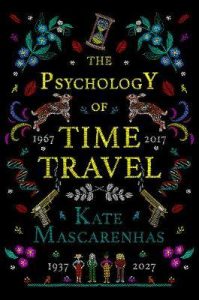 In 1965, time travel ignites Barbara’s manic depression, and the other pioneers—ambitious Margaret, compassionate Lillian, and social butterfly Grace—leave her behind to form The Conclave, an autonomous organization commercializing time travel. Multiple storylines converge to determine the identity of the woman found dead of four bullet wounds in a locked room. The investigation for this unique whodunit plays out in various timelines with characters’ ages often not corresponding chronologically. There’s manipulation, subterfuge, and espionage afoot throughout the nation and throughout time. The time travel details are concrete, with the fuel posing a danger if not handled appropriately. There’s even a time travel glossary included at the end, which makes one try that much harder to buy into the concept. Macarenhas gives the reader glimpses into the thoughts of characters, providing more depth to a story that might easily go astray with so much time-hopping chapters. Readers who like speculative fiction with compelling characters and complex relationships will appreciate this story that readily lends oneself to suspend belief, a realistic time travel story, if you will. It’s definitely worth the time! Ha! I was fortunate to receive a copy from the publisher through Net Galley.
 In Brazil, Nazi fugitive Klaus Holland, aka Matheus Esperanca, raises his son by a prostitute with a Jewish kapo from Udenspul, the concentration camp he commanded. The son, Deus, considers the kapo his mother, and after her death, takes mysterious photos from her to a professor in his US university to research his ancestry, where he learns the true identity of his father and the extent of his crimes. Olokita brilliantly uses the concept of god as a measurement of morality, or rather lack of humanity, as Klaus plays God in determining who dies, though his own religious beliefs remain deliciously ambiguous. The character development is so well done that dear reader will be researching names. Although written in third person for everyone else, Klaus is in first person, bringing the reader up close and personal to a man with his own version of right and wrong based on his complete lack of empathy, exploring the idea of how powerful he believes himself. The ending revelation is quite coincidental and is evidenced only by Klaus’ perception, so it’s not clear why it’s readily believed by Deus and his new love Heidi. It’s anti-climactic after the delightful irony of Klaus’ downfall. With so many rumors, legends, and news items, inspiring a plethora of literature, on the Holocaust, this unique story of a fugitive hiding out in South America is a definite must-read. It’s themes rove beyond the simple good vs. evil and the idea that one can distinguish such traits in anyone, with characters revealing the dangers within themselves. I received a digital copy of this fantastic novel from the author for an honest review.
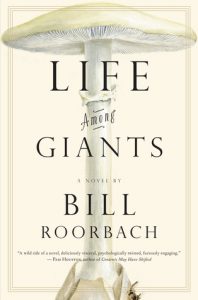 At 17, David witnesses his father’s public assassination for turning state’s witness, his mother collateral damage, his life spared due to spent ammo. He spends decades piecing together evidence to determine the killer’s identity, all while living his life as an NFL quarterback for the Dolphins, a random lover of the famous dancer Sylphide (who lives across the pond from his childhood home) and her protege Emily—introduced by him, and a restaurateur. His sister parcels out relevant information on rare occasions, spending her grief-stricken adulthood playing professional tennis, fighting mental illness, and searching for her parent’s killer against her boyfriend’s pragmatic advice. As Sylphide moves in and out of David’s life, secrets come unmoored and land at his feet every so often. Roorbach has built a fine cast of complex and extraordinary characters, nuanced to the hilt, integrity intact throughout the novel, all maddeningly non-forthcoming for page-turning tension. It can be awkward to follow the timeline back and forth, and David’s discoveries can be out of sync, as when he realizes his sister’s major secret years after his parent’s demise, and then in a following flashback is explicitly told the secret by his sister herself. No opportunity is missed to reference Emily as “the negress”—was that even used as late as the 70s and into the 80s? Her parents could have been a bit more rounded out as individuals instead of representations. These few distractions don’t detract from a unique story with an intriguing storyline and intense meta sex scenes. Roorbach is almost his own genre. He’s the Mainer Carl Hiassen in his dedication to untangling and tying up multiple storylines and presenting humans in all their glory and warts.
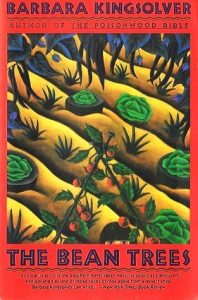 Marietta left Kentucky after high school, changed her name to Taylor, and become a mother through an unexpected incident, ending up in Tucson with a single mother roommate and a job as a tire mechanic for a woman who rescues undocumented immigrants. Selectively mute from obvious chronic abuse, her newly acquired daughter Turtle learns to trust Taylor, who learns to trust in her new friendships as she seeks a way to keep Turtle legally and build their life in Tucson.